
Operator knowledge
Inside the globe: what we have learned running giant snow globes
Everything on this page comes from our own operating records — stopwatch timings, group counts, curtailment logs, site photographs and debriefs. It is the detail we would want if we were the ones booking the attraction, and it is the reason our quotes arrive with numbers rather than adjectives.
What are GlobeHire's operating numbers?
Our figures come from timed full operating days, not single best-case cycles. These are the numbers we plan capacity and staffing against.
- Fastest sustainable group cycle
- 3 minLoad, run, clear and reset with our two operators. Timed across full operating days, not a best-case single run.
- Groups per hour at peak
- 20The realistic ceiling on a staffed queue. We plan capacity on 16–18 to leave headroom for photos and accessibility.
- Groups on a typical day
- 95–140Depends on opening hours and whether the globe runs continuously or in timed sessions.
- Equipment size (W x D x H)
- 3.5 mNeeds a 5.5 x 5.5 m operational area with 4 m clear height for the perimeter and crew access, plus separate queue space sized to expected footfall.
- Operational staff as standard
- 2Additional crew is arranged for break cover, extended hours, split shifts or particular event requirements.
- Public liability cover
- £10mCover held for the 3.5m giant snow globe, with RAMS supplied before every install.
- In-globe experience
- 60–90 sLong enough for guests to throw the medium toward the internal fan, get their photos and leave smiling.
What have we learned that you only learn on site?
Five things that changed how we position, staff and run the globe — each one discovered on a live site rather than on paper.
The queue is the attraction, not the globe
The globe holds a crowd whether or not it is running. We now position the queue line so waiting guests face the globe interior, because a visible group inside recruits the next four groups behind them. Turn the entrance away from the main desire line and dwell time drops noticeably on the same site.
Floor surface decides your day
On polished retail floors the medium travels further than most venues expect, so we bring matting sized to the spill pattern rather than the globe footprint. On grass we insist on trackway or hard standing: the issue is not the globe, it is trolleys, buggies and wet shoes at the entrance.
Guests control the medium, so behaviour is coachable
Nothing circulates unless a guest throws it toward the internal fan. That single design fact makes the operator brief the most important safety control we have — a ten second brief before entry removes almost every incident risk and improves the photos.
Timed sessions beat open queueing after 90 minutes
Open queueing works for a launch hour. Beyond that, families abandon lines they cannot see the end of. Switching to short timed slots with a return time keeps the same throughput while cutting visible queue length by roughly half.
Evening is when the globe photographs best
Lit from inside against a darker background, the globe produces the images marketing teams actually reuse. On outdoor sites we now recommend the last two operating hours be the ones you staff for content capture.
What does our own testing show?
We time and record our own operating days so we can answer capacity questions with evidence. Here is the method behind each figure and what it means for your booking.
How many groups can a two-person crew realistically process per hour?
- How we tested
- Stopwatch timing of full operating days across indoor and outdoor residencies, recording every load, run and reset rather than sampling.
- What we found
- A sustained rate of 16–18 groups per hour, peaking at 20 when the queue is pre-briefed and groups are ready at the door.
- What it means for you
- Plan capacity on 16–18. Any supplier quoting 25+ per hour with our two operators is quoting a single cycle, not a day.
Does group size change throughput?
- How we tested
- Comparing mixed family groups against fixed pairs on the same site over consecutive days.
- What we found
- Larger groups reduce cycles per hour but raise total guests served by around a fifth, because loading time does not scale with headcount.
- What it means for you
- If the brief is reach, run fuller groups. If the brief is a personal branded moment, run smaller groups and accept fewer guests.
How far does the medium travel outside the globe?
- How we tested
- Marking spill radius at the end of each operating day across several floor types.
- What we found
- Almost all carry-out happens within about a metre of the exit, concentrated at the point guests brush themselves down.
- What it means for you
- One matted brush-down zone at the exit removes most of the cleaning burden — full-area matting is rarely needed.
What actually stops an outdoor day?
- How we tested
- Reviewing our own curtailment records against on-site wind and rain readings.
- What we found
- Wind, not rain, is the deciding factor. Sustained gusts above the agreed operating limit stop the day; drizzle rarely does.
- What it means for you
- Agree a wind-speed limit and a decision-maker in writing at booking, and build a contingency slot into multi-day runs.
How do we deliver a booking?
Every booking runs through the same six stages, and each stage produces a document or a figure you keep. Site proof first, quote second — never the other way round.
- 1
1. Site proof
We measure the footprint, headroom, floor type, power route and the desire line guests already walk, either on a video call or in person.
You receive: A site proof sheet stating where the globe goes, where the queue forms and where guests exit.
- 2
2. Flow design
We set group size, cycle length and whether the day runs open-queue or timed sessions, based on your expected footfall pattern.
You receive: An hour-by-hour capacity plan with the realistic group count for your opening hours.
- 3
3. Message dressing
We dress the globe and the surround to your own campaign message and brand guidelines — the globe is the vehicle, your message is the content.
You receive: A dressing plan covering interior medium, exterior surround, signage and photo-share prompt.
- 4
4. Compliance pack
We issue the risk assessment and method statement for your specific setting, with public liability cover confirmed.
You receive: A venue-ready RAMS pack, sent before install rather than on the day.
- 5
5. Run and record
Our operators brief every group, keeps the cycle to time and logs group counts through the day.
You receive: A group-count record you can put in your own post-event report.
- 6
6. Debrief
We review what the counts and the photographs show, and what we would change on the same site next season.
You receive: A short written debrief with recommendations for the next booking.
How long does each stage really take?
These are the timings from our own bookings, including the paperwork and the daily open-up most suppliers leave out.
| Phase | How long it takes | What happens |
|---|---|---|
| Enquiry to quote | 1–2 working days | Faster if you can send site photos, floor type and opening hours with the enquiry. |
| Site proof | 30–45 minutes | Video call for straightforward indoor sites; in person for complex or outdoor positions. |
| RAMS issued | Within 5 working days of confirmation | Setting-specific risk assessment and method statement, ahead of any venue deadline. |
| Install | 2–3 hours | Includes positioning, power, matting, dressing and a test cycle before doors. |
| Daily open-up | 20 minutes | Medium top-up, matting check, lighting and test cycle. |
| De-rig | 1.5–2 hours | Including full medium recovery and a clean hand-back of the space. |
| Debrief | Within 5 working days | Group counts, photographs and recommendations for the next run. |
What shapes the cost of a booking?
We quote per booking rather than publishing a rate, because these seven factors move the figure far more than the globe itself does.
- Length of runA weekend residency and a five-week seasonal run are priced very differently per day. Longer runs spread transport and install across more operating days.
- Indoor or outdoorOutdoor positions add weighting, weather contingency and often trackway or power distribution.
- Staffing patternTwo operators cover a standard day. Peak weekends, extended hours or two-lane operation need more crew.
- Dressing and themingStandard seasonal dressing is included in the quote; bespoke branded surrounds, printed graphics and additional props are costed separately.
- Additional propsExtra props, seating, backdrops and lighting can be hired alongside the globe at additional cost.
- Location and accessDistance, loading windows, lift access and out-of-hours install all affect the figure.
- Capture and mechanicsAdding share prompts, data capture or a prize mechanic changes both staffing and build.
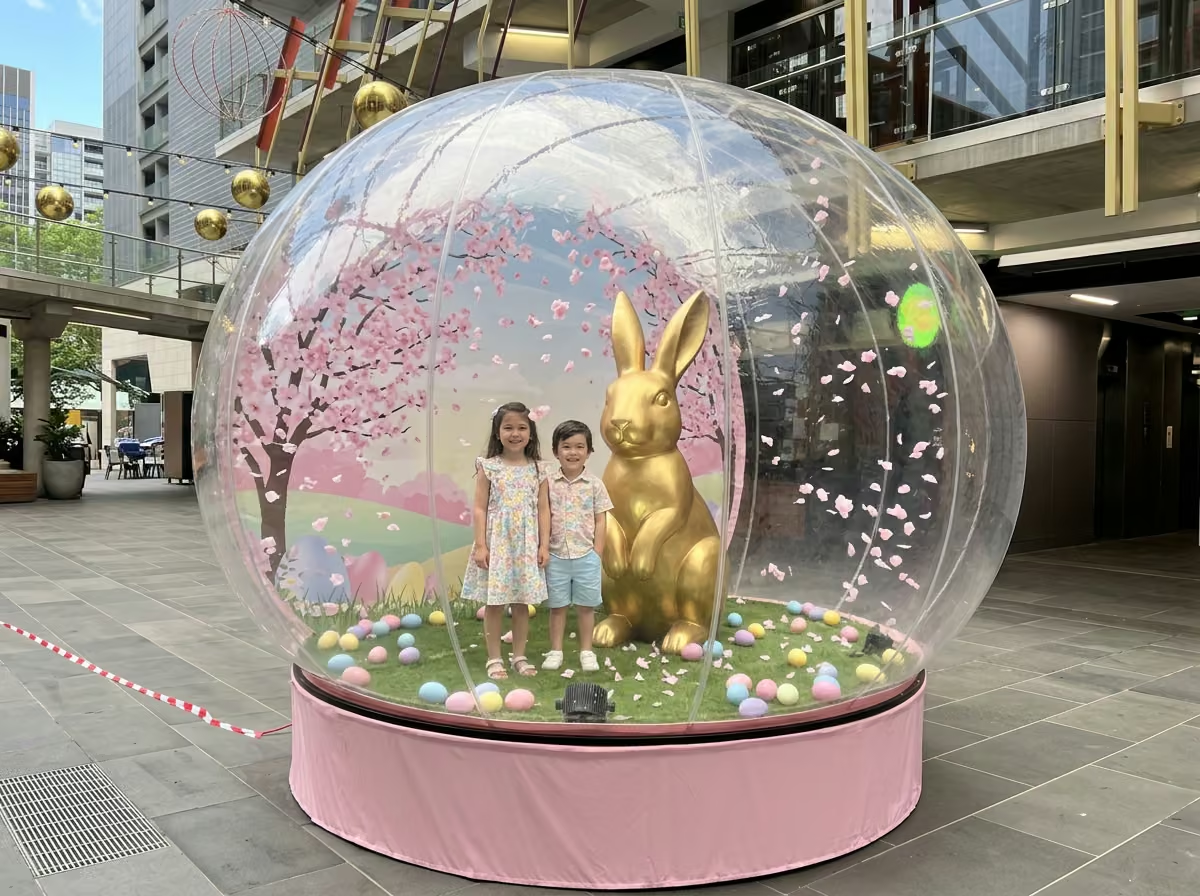
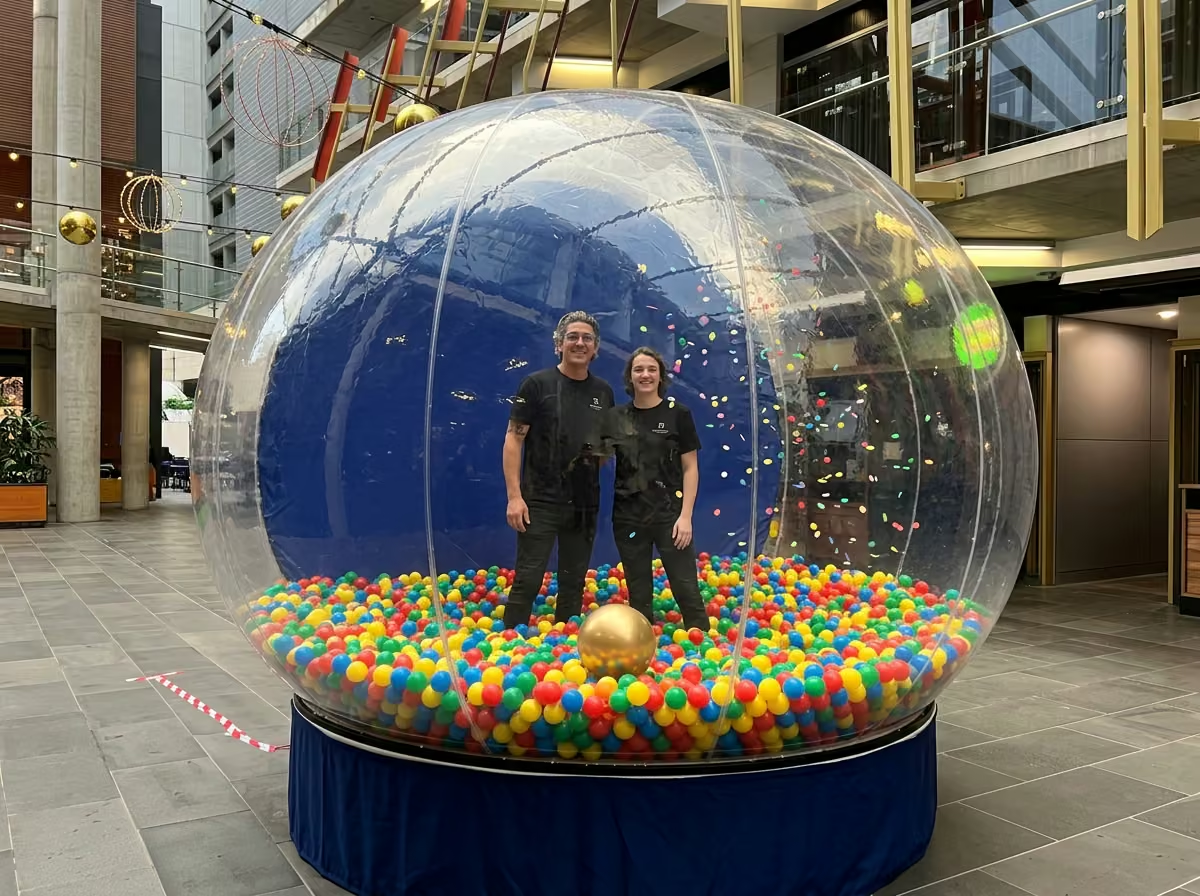
What does it actually look like?
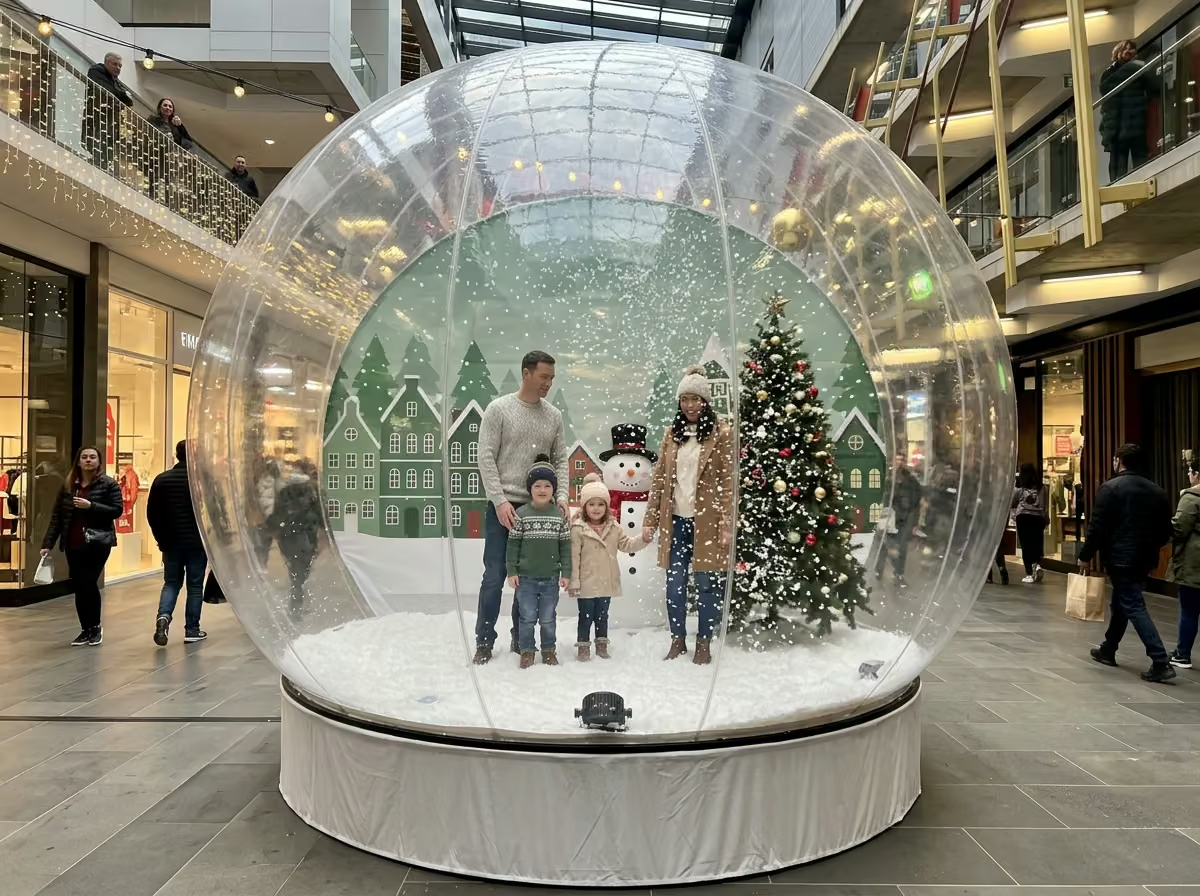
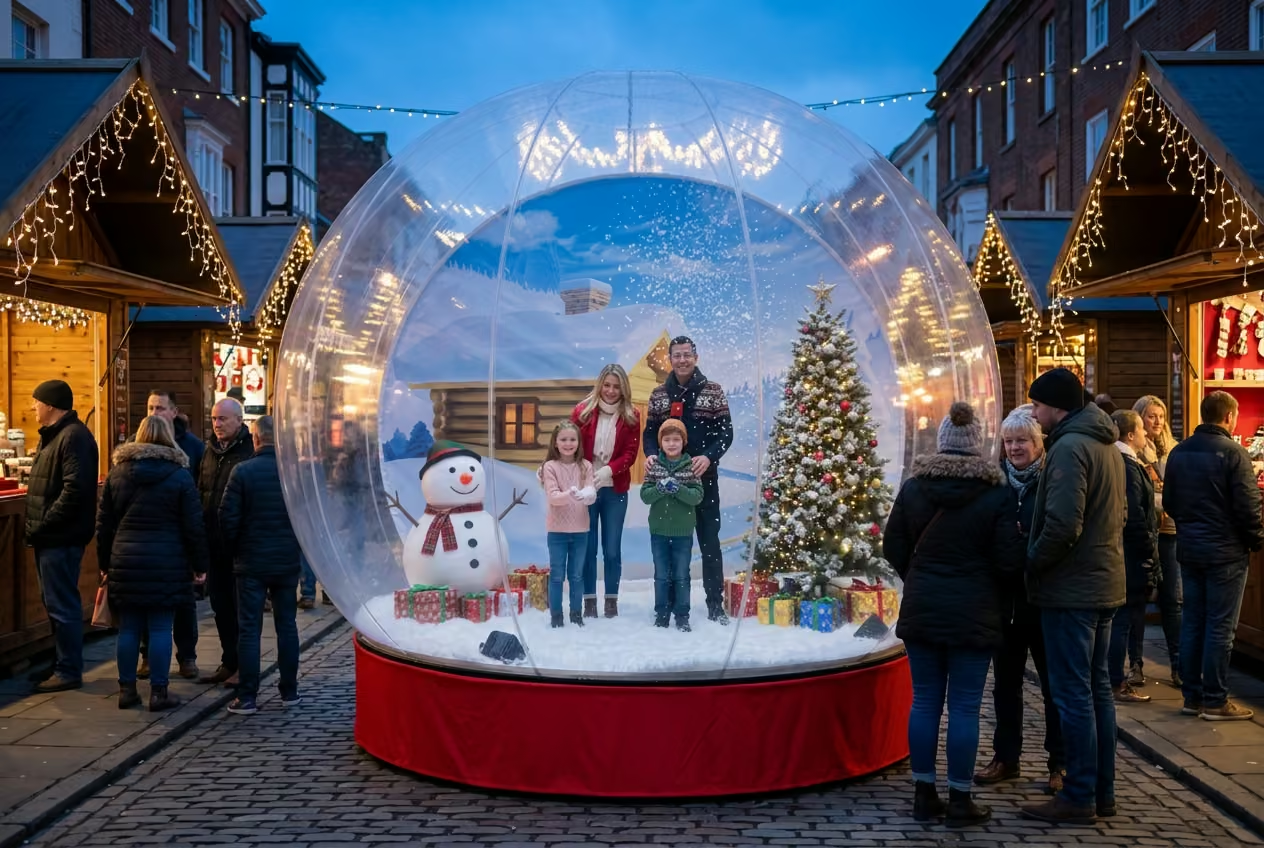
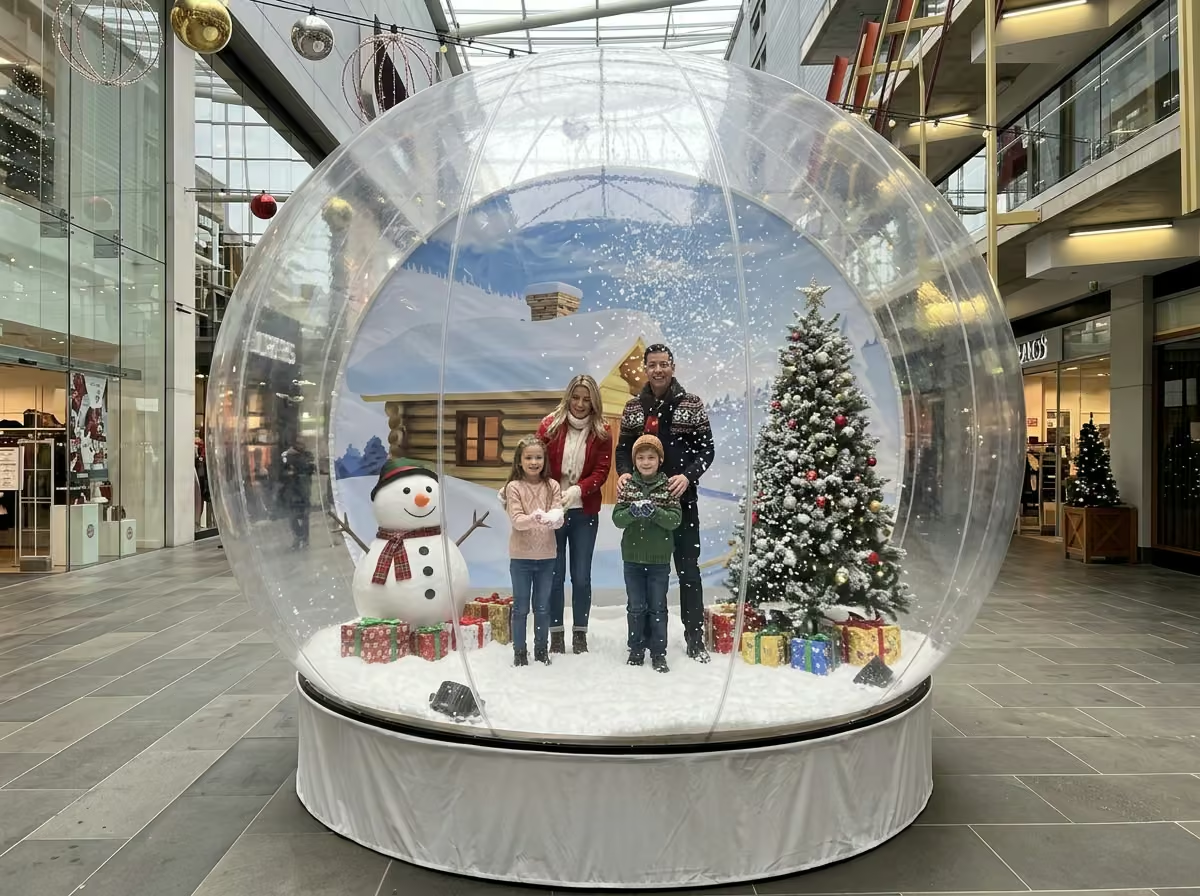
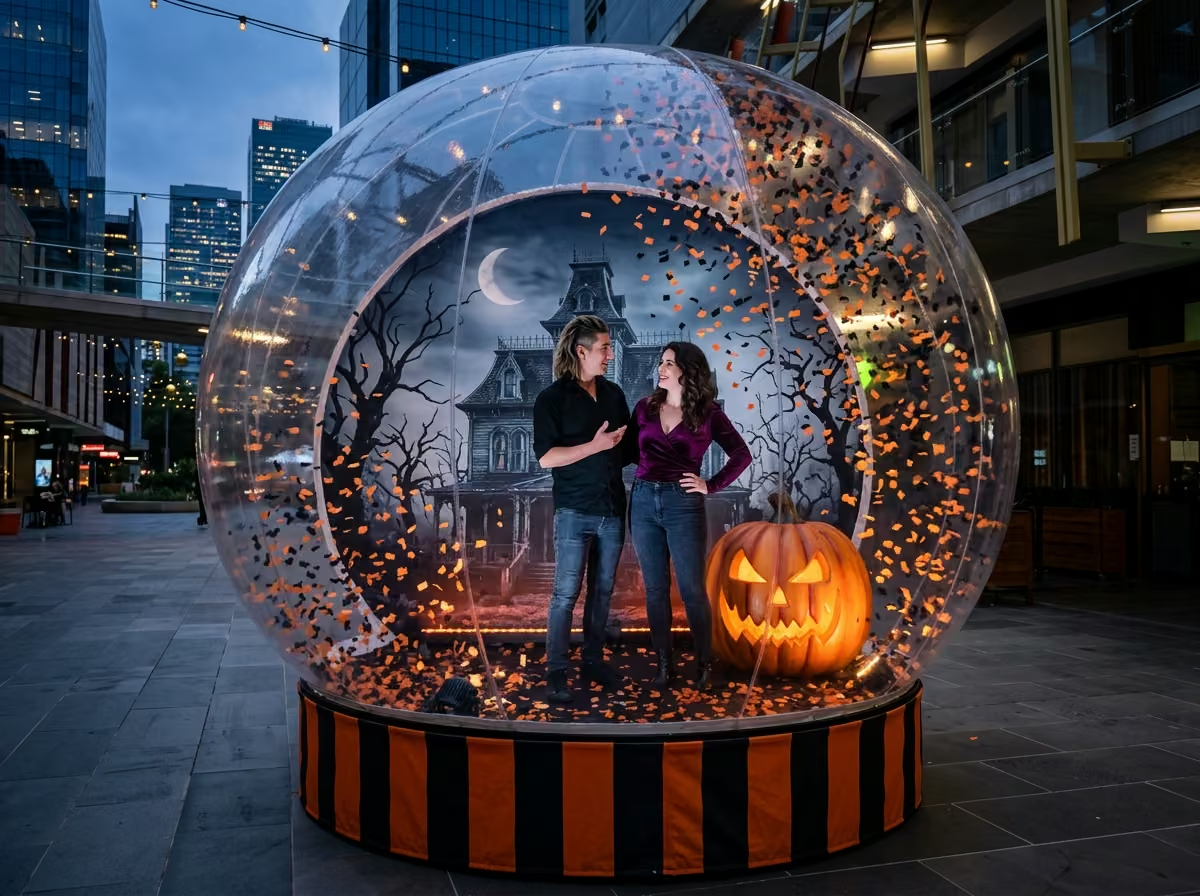
Our own photographs from live installs, captioned with the operating detail each one shows.
What changes once the globe is in the space?
The honest before-and-after: what the space did before the globe arrived, and what it does during a residency.
| Aspect | Before | After |
|---|---|---|
| The space | An empty atrium or square that guests crossed on their way somewhere else | A destination with a visible queue, a photo backdrop and a reason to stop |
| Dwell time | Minutes — walk-through traffic | Twenty minutes or more per family once queue, run and photos are counted |
| Content | Stock seasonal imagery in the campaign | Guest-generated photographs and video from inside the globe, reused across the run |
| Staffing load | Multi-person activations needing constant supervision | Two briefed operators running a fixed cycle, with counts logged |
| Compliance | Chasing paperwork from a supplier in the final week | Setting-specific RAMS and £10m cover issued well before install |
How does the globe compare with the alternatives?
Three comparisons we are asked for on nearly every enquiry, answered with our own throughput and staffing figures.
Giant snow globe or a traditional grotto?
A grotto sells a scripted visit with a character. A globe sells a fast, repeatable photograph that works for all ages and needs far less staffing.
| Factor | Giant snow globe | Traditional grotto |
|---|---|---|
| Throughput | 16–20 groups per hour | Typically 8–12 groups per hour |
| Staffing | Two operators | Character, host and often a queue manager |
| Audience | All ages, including adults and teens | Mainly under-8s and their families |
| Footprint | 5.5 x 5.5 m operational area plus queue | Multi-room build, far larger |
| Branding | Interior and surround dressed to your campaign | Usually fixed to a Christmas narrative |
Indoor atrium or outdoor site?
Indoor gives you certainty; outdoor gives you scale and better night-time imagery. Most multi-week bookings choose indoor for reliability.
| Factor | Indoor | Outdoor |
|---|---|---|
| Weather risk | None | Wind limits can pause operating |
| Photography | Consistent, depends on venue lighting | Best-in-class after dark with the globe lit |
| Set-up | 2–3 hours, matting and power | Longer: weighting, trackway, distribution |
| Footfall source | Existing venue visitors | Event audience plus passing trade |
| Cleaning | Matted brush-down zone at exit | Same, plus wet-weather entrance management |
Open queue or timed sessions?
Open queue for the first busy hour, timed sessions for the rest of the day. Throughput stays the same; the visible queue halves.
| Factor | Open queue | Timed sessions |
|---|---|---|
| Perceived wait | Grows quickly, causes drop-off | Guests leave and return, so the wait feels short |
| Groups served | 16–20 per hour | 16–20 per hour |
| Data capture | Hard while queueing | Natural at the booking-in point |
| Best for | Launch moments and short events | Full days and multi-week residencies |
What mistakes do we see most often?
Six avoidable problems we have watched happen on real sites, with the fix we now build into the site proof.
Booking the space before checking the headroom
Where we see it
Indoor atriums with low service bulkheads and hanging Christmas decor
The fix: Confirm 4 m clear height at the exact position, not the room average, before the space is signed off.
Placing the globe where the queue blocks a fire route
Where we see it
Mall walkways and marquee entrances
The fix: Draw the queue on the plan, not just the unit. We mark the line as part of the site proof sheet.
No named decision-maker for outdoor stand-downs
Where we see it
Multi-day outdoor runs in autumn and winter
The fix: Name one person at booking who can call a pause on wind, and agree the limit in writing.
Treating the globe as the whole activation
Where we see it
Brand campaigns with no capture or follow-up
The fix: Add a share prompt, a data capture step or a prize mechanic. The globe creates the moment; the mechanic gives it a job.
Staffing the quiet hours and thinning the peak
Where we see it
Weekend retail residencies
The fix: Use the capacity plan. Put the additional operator on the two hours that actually carry half the day's groups.
Leaving the photo moment unguided
Where we see it
Almost every first-time booking
The fix: Light the scene for mobile-phone photos after dark, place a branded share prompt where guests see it, and let groups take their own pictures before exiting.
What does our team say about running it?
Commentary from the people who install, brief and run the globe, on the decisions that matter most.
“The globe is a photograph machine. Everything we do on site — lighting, backdrop, group size, how long people stay inside — is aimed at the picture the guest takes home.”
“The safest attraction is the one where the guest controls the action. Nothing moves in our globe unless someone throws it at the fan, and that makes the brief the control.”
“Venues ask for footfall. What they usually need is dwell — a reason to stay in the space for twenty minutes rather than walk it in five.”
Which lessons changed how we work?
Five specific changes to our own process, each one triggered by something that went wrong or could have gone better.
We stopped quoting before a site proof
Early quotes without measurements led to install-day surprises. Every quote now follows a video call or visit, and the site proof sheet goes out with it.
We size matting to the spill pattern, not the globe
Recording carry-out at the end of each day showed the problem is concentrated at the exit. Matting there solved more than covering the whole area ever did.
We write the wind limit into the booking
Verbal agreements failed on the one windy weekend that mattered. It is now a written term with a named decision-maker.
We log group counts every hour
Clients need evidence, not impressions. Hourly counts turned into the numbers our clients now use in their own post-event reports.
We brief every group, without exception
The ten second entry brief is the single biggest driver of both safety and photo quality. It is not optional, even at peak.
What do clients ask us before booking?
The questions we answer most often, in the words clients use — with the direct answer first.
How much space do we actually need?
A 5.5 x 5.5 m operational area with 4 m clear height for the 3.5m globe, plus space for a queue on one side and an exit on the other. We confirm the exact position on a site proof before you commit the space.
How many people can go through it in a day?
Around 95–140 groups on a typical staffed day, based on 16–20 groups per hour and your opening hours. We give you the hour-by-hour figure for your site rather than a headline number.
Is the snow safe, and does it go everywhere?
The medium is a plant-based artificial snow made from vegetable starch derived from potato and turnip; it is non-toxic, non-allergic and supported by material and fire certification on request. Nothing circulates unless a guest throws it toward the internal fan, so the activity is guest-controlled. Carry-out concentrates within about a metre of the exit, which a matted brush-down zone handles.
What happens if the weather turns?
Light rain or intermittent showers rarely stop an outdoor day. However, torrential or heavy rain and sustained wind above the agreed limit do. We set that limit and name a decision-maker in writing at booking, and build contingency into multi-day runs.
Can it carry our branding?
Yes. The interior medium, exterior surround, signage and photo prompt are all dressed to your own marketing message and brand guidelines.
What does it cost?
Globe hire starts from £1,395 plus VAT for the base package, which includes the operating crew across your opening hours up to six hours a day. Add-ons — custom printed backdrops, printed surround skirts, marketing literature and branding, and additional theming — are priced separately, and longer delivery runs such as Scotland sit above the starting figure. Call 0330 043 6185 or send your dates and site details for an itemised quote within 48 hours.
What paperwork will our venue get?
A risk assessment and method statement written for your specific setting, plus confirmation of £10 million public liability cover — issued before install, not on the day.