
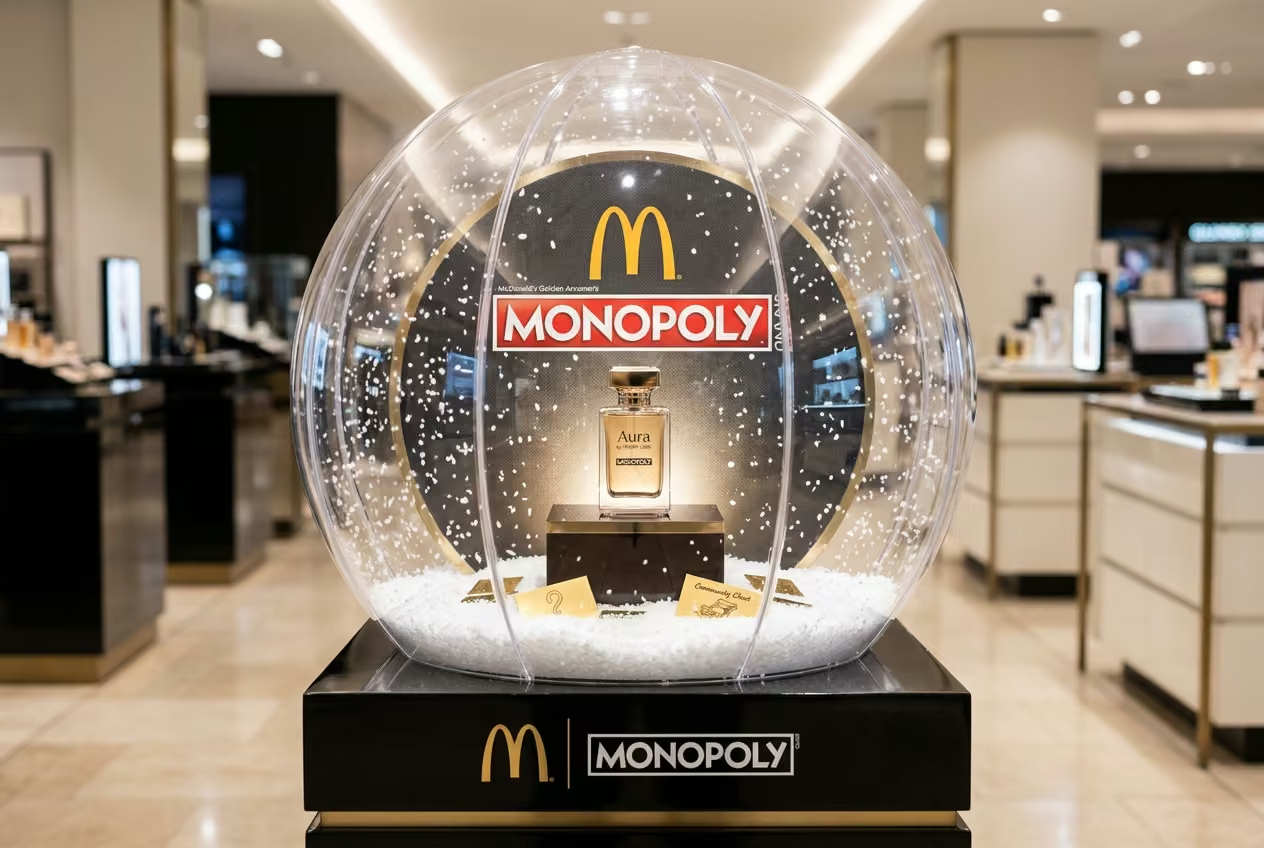
Space and footprint
The equipment itself is 3.5m wide x 3.5m deep x 3.5m high, and we ask for a 5.5m x 5.5m operational area with 4m clear height around it. Plan for that plus a queue lane to one side and a clear working margin for the crew.
Indoors that usually means keeping the pitch off the tightest part of a walkway. Outdoors it means checking what is directly above and beside the pitch — festoon runs, tree canopy, signage arms — before the pitch is committed.
- ❄Equipment: 3.5m wide x 3.5m deep x 3.5m high
- ❄Operational area: 5.5m wide x 5.5m deep with 4m clear height
- ❄The additional space is not spare room — it carries the rope-and-post perimeter, staff access and the margin that discourages the public, particularly children, from touching the inflated structure
- ❄Queueing space is planned on top of the operational area, sized to your expected footfall and the layout of the site
Ground and surface
Level, firm ground: paving, tarmac, hardstanding or a level indoor floor. Soft or sloping ground changes the ballast plan.
On grass and other soft surfaces the question is not whether the globe can go there but how it is secured and where the ballast sits. Our outdoor park method statement covers that setting specifically.
Power
A reliable standard supply for the whole of operating hours, feeding the blower and the internal fan.
The blower runs continuously while the globe is inflated, so the feed cannot be a shared spur that gets switched off between shifts. Where a site has no fixed supply, a stable generator feed works, provided cable runs are matted and signed.
- ❄Access to two standard 13A sockets
- ❄Stated power draw: 1.8 kVA / 8.0A
- ❄Where suitable mains power is not available, we recommend the client arranges an appropriate safe generator solution — generator hire is not something we currently provide
Access and load-in
Kit is trolleyed in, so the route needs continuous width, adequate door clearance and — where relevant — a goods lift that takes the load.
The route is agreed before the install date rather than found on the morning. Where the venue allocates a service corridor, we plan the load-in against that corridor, not the public entrance.
- ❄A minimum clear width of 0.85m through doorways and corridors
- ❄Delivery is ordinarily in a panel van roughly equivalent to a Citroën Relay L2H2
- ❄Tell us early about stairs, lift access, restricted doorways or corridors, uneven surfaces, obstructions, or an unusually long distance between unloading point and installation position
Install and de-rig timings
Installation takes around two to three hours; de-rig timing is agreed separately. Both are scheduled around the venue's trading or event hours.
The two-to-three-hour allowance covers positioning, inflation, ballast, dressing the internal scene, cable management and a functional check before handover. Where a venue can only offer a narrow window, that window is the first thing we plan the day around.
Outdoor-specific requirements
Outdoors adds ballast, cable protection and wind monitoring against the thresholds in the method statement.
Rain is manageable. Wind governs whether an outdoor globe operates, and the crew closes and reopens it accordingly. The indoor versus outdoor guide sets out how that decision affects programming.
- ❄For outdoor installations we normally operate with 200 kg of ballast, distributed appropriately beneath and throughout the staged framework
- ❄The attraction does not operate above 24 mph (38 km/h) — an upper limit, not a target, and the crew may suspend earlier on site conditions
- ❄An anemometer is taken to every outdoor install: measured before opening, re-checked during operation, and any lower manufacturer limit applies instead
- ❄Light rain and drizzle do not necessarily stop operation; torrential rain means a pause, and the globe may be deflated and protected until it is safe to reinstall
- ❄Heavy snowfall may mean suspension or cancellation, and any decision ultimately rests on conditions on site and safe operation
Access, steps and sensory conditions
The attraction is not step-free. Entry is up approximately two conventional steps, with a small threshold lip of around four inches at the zipped PVC entrance.
We would rather be plain about that than leave an organiser to discover it on site. We do not currently operate a purpose-built wheelchair-accessible globe, although acquiring an accessible version is something we are considering for the future. Guests with specific access requirements are very welcome to raise them with us before booking so arrangements can be considered properly.
Our crew will make reasonable efforts to help guests, but they are event operators rather than trained manual-handling carers, and should not be expected to lift wheelchair users or disabled guests. Where physical assistance is needed, a parent, carer or appropriately trained support person may need to be involved.
What it is like inside
The globe is held up by a substantial continuous fan and blower system, so there is a noticeable, constant whooshing airflow sound inside. The artificial snow settles on the floor until guests kick, throw or push it towards the airflow, at which point it circulates around the globe and then settles again. The Golden Ball globe uses conventional ball-pit-style balls instead of airborne snow.
Lighting is white, cool-to-touch LED, and we prefer high-lumen LED equipment. We cannot guarantee a completely flicker-free environment or make any sensory or medical assurances, so guests with particular sensory requirements are encouraged to talk to us before the event.
Common mistakes when planning a giant snow globe attraction
In our experience four things cause most of the avoidable problems: booking late, choosing on headline price alone, not checking documentation, and planning only for the structure.
- ❄Booking too late — availability tightens as key dates approach, particularly for Christmas, so plan early where the date matters
- ❄Choosing solely on lowest price — weigh the whole offering: equipment, documentation, insurance, staffing, reliability, install planning and on-site support
- ❄Not verifying documentation — establish what safety, insurance, material and fire, electrical and inspection paperwork exists for the actual attraction being supplied
- ❄Leaving branding too late — where bespoke artwork cannot be produced in time, our standard theming has to be used instead, which can dilute the intended campaign impact
- ❄Underestimating operational space — planning for the 3.5m structure alone is not enough; the operational perimeter, rope-and-post barrier, crew movement and queueing space all need room
Paperwork the venue receives
A setting-specific risk assessment and method statement, on a 5x5 risk matrix, plus public liability confirmation.
Four settings are covered: generic, indoor shopping centre, outdoor public space and outdoor park. £10 million public liability cover is in place for the giant snow globe, electrical equipment is PAT tested and materials are specified as flame retardant.