
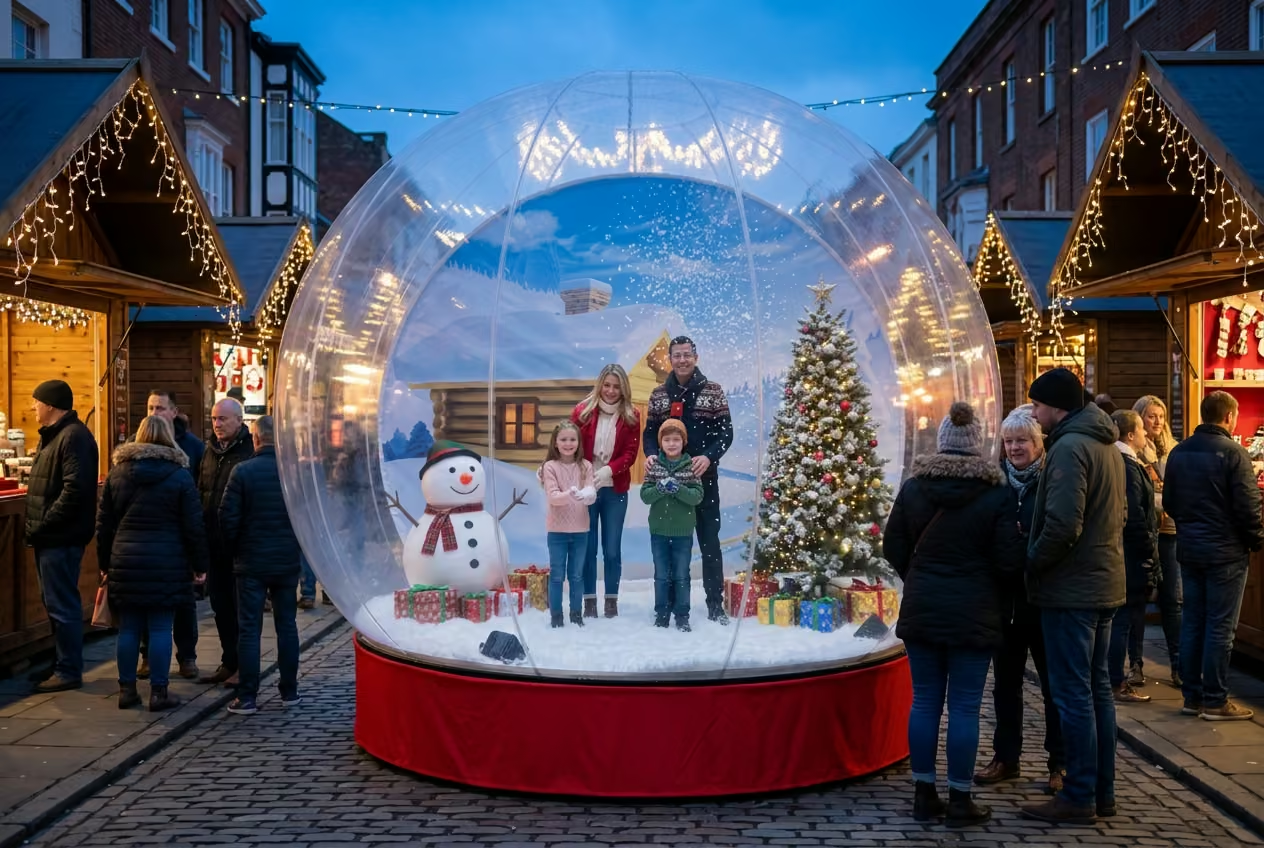
An illuminated centrepiece for a city Christmas market
A weekend-only outdoor residency with weather-ready staging and evening lighting.
- Globe
- Christmas Globe
This is an illustrative install format showing how the globe is typically planned and run. It is not a record of a specific client project; venue details and results are not shown until genuine, approved project write-ups are available.
What did the client want to achieve?
Give the market a hero attraction that photographed well after dark and gave visitors a reason to stay into the evening trading peak.
What was the starting situation?
The square had strong daytime trade but thinned out after 16:00, when light levels dropped and there was nothing visually anchoring the space.
What were the challenges?
The constraints that shaped how the activation was designed and run.
- Hard-standing public square shared with market traders and pedestrian routes
- Weekend-only operation across six separate weekends
- Wind-speed operating limits and an adverse-weather de-rig plan agreed with the organisers
- All photography happening after dark, so lighting had to do the work
Our approach
We designed for the after-dark window first. Lighting, backdrop contrast and the stage position were all set for 16:00–19:00, when almost all shared content is captured at a Christmas market.
The solution we delivered
A weighted outdoor stage that stayed in place across all six weekends, an evening lighting scheme built for photography, and written wind-speed limits with a defined pause and de-rig trigger.
The brief in full
The organisers needed a hero attraction that photographed well after dark and could be operated safely on a hard-standing public square shared with market traders. Operating hours ran 11:00–20:00 on Saturdays and Sundays, with wind-speed limits agreed in advance and a de-rig plan for adverse weather.
What we supplied
- Weighted outdoor staging suitable for public squares
- Evening lighting scheme for after-dark photography
- Weather monitoring and wind-speed operating limits
- Trained operators managing capacity and session length
- Event-specific risk assessment and method statement
What happened during the process?
From first site visit to hand-back, in the order it ran.
- 1Square surveyConfirmed ground type, ballast plan, pedestrian flow and the distance to trader pitches and power.
- 2Weather procedureWind-speed operating limits, a pause trigger and a de-rig trigger written into the method statement and signed off by the event team.
- 3Base installWeighted staging installed once and left in place for the full six weekends.
- 4Weekend prepEach Saturday opened with a dressing, lighting and media check rather than a full build.
- 5Operate11:00–20:00 Saturday and Sunday, capacity managed by our trained operators.
- 6De-rigFull strip and square clearance after the final Sunday.
Products, materials and services used
Everything specified for this project, including consumable media and crewed services.
- 3.5m walk-in globe with weighted outdoor staging and ballast
- Evening lighting scheme with warm festive wash and backdrop lighting
- Weather-resistant themed dressing and signage
- Eco artificial snow made from vegetable starch (potato and turnip), suitable for outdoor use
- Anemometer and wind-monitoring procedure
- Crewed operation, crew cover and event-specific RAMS
How long did it take?
Lead times and durations for a typical install of this format.
- Enquiry to quote
- Under 48 hours
- Booking lead time
- Approx. 10 weeks (public square permissions)
- Base install
- Half a day, once for the whole run
- Operating pattern
- 6 weekends, 11:00–20:00 Saturday and Sunday
- De-rig
- Around 2 hours after the final session
What shaped the cost?
Costed as a weekend-pattern residency: the base stayed in place, so only crewed operating days were charged at an operating rate. Outdoor ballast, lighting and the weather-monitoring procedure were the main additions over an indoor equivalent.
We quote every project individually rather than publishing rates. Send your dates and venue for a tailored figure within 48 hours.
What problems came up, and how were they solved?
Every project throws something. These are the issues met on site and the fix that resolved each one.
Problem: A Saturday afternoon gust reached the agreed operating limit.
How we solved it: The crew paused entries under the written procedure, held the queue and reopened 40 minutes later. Because the trigger was documented, the decision needed no negotiation on the day.
Problem: The first lighting layout blew out faces in photos taken at dusk.
How we solved it: The wash was rebalanced toward the backdrop with a softer front fill after the opening weekend, which fixed contrast for the rest of the run.
Problem: Queue overflow crossed a trader's frontage during the evening peak.
How we solved it: Barriers were re-laid to turn the queue back on itself, keeping the trader's frontage clear without reducing capacity.
Before and after
What changed between the site as we found it and the site as it ran.
| Aspect | Before | After |
|---|---|---|
| After 16:00 | Footfall thinning as light dropped. | The busiest hour of the day at 16:00–17:00. |
| The square | Stalls with no central focal point. | An illuminated centrepiece visible from every approach. |
| Weather planning | Ad-hoc decisions on the day. | Written wind limits with defined pause and de-rig triggers. |
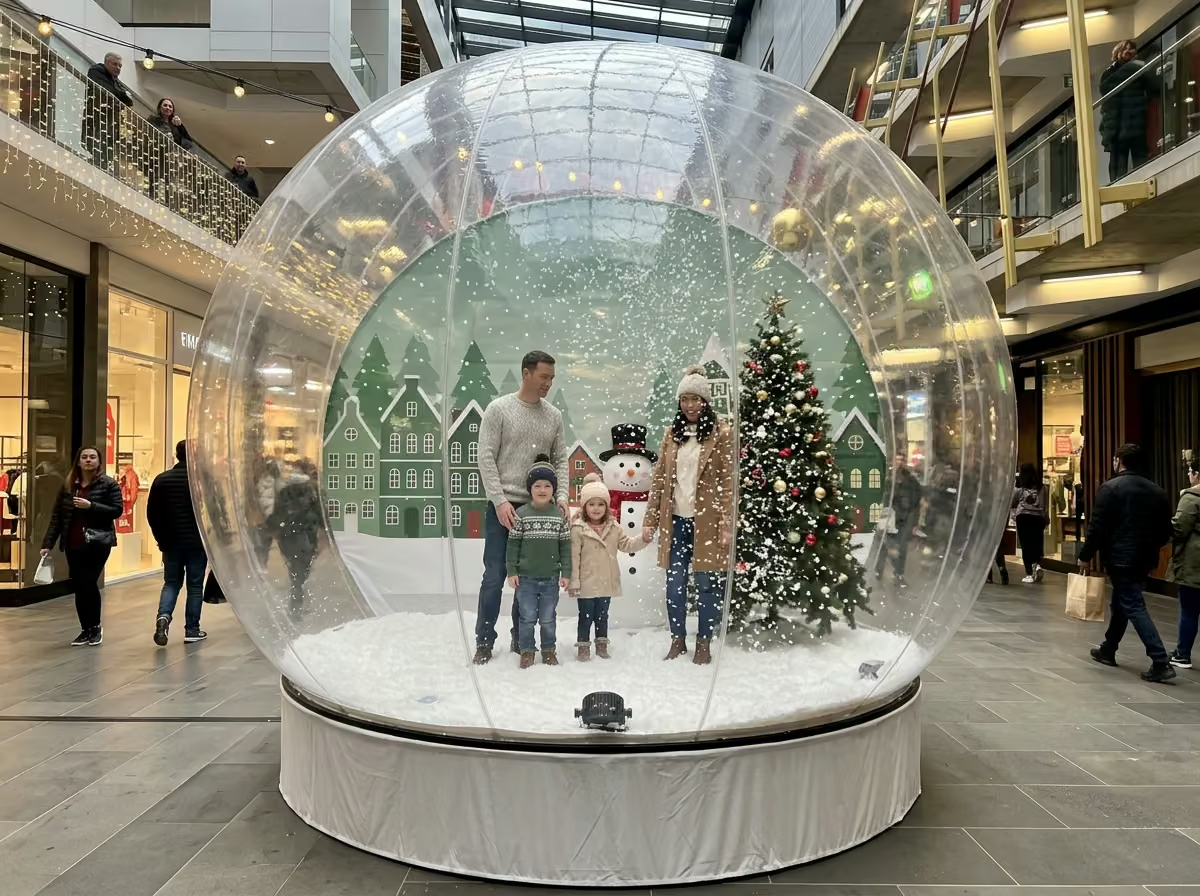
How this format could look
Reference images showing how a similar installation can be built, dressed and operated in a comparable space.
What made it work
The parts of this format worth copying if you're planning something similar.
Light it for the after-dark crowd
Most market photos are taken between 16:00 and 19:00. The lighting scheme was designed for that window, which is where almost all the shared content came from.
Agree wind limits before you arrive
Operating limits and a de-rig trigger were written into the method statement, so the decision to pause was procedural rather than a negotiation on the day.
Weekend-only residencies still need a fixed base
Weighted staging stayed in place across the six weekends, so each Saturday started with a dressing check rather than a full install.
Plan your version of this
Send your venue, dates and objective. We'll confirm whether this format fits your site and come back within 48 hours with a tailored quote.